2013-Nov-06
Great Lakes Commission Annual Meeting 2013
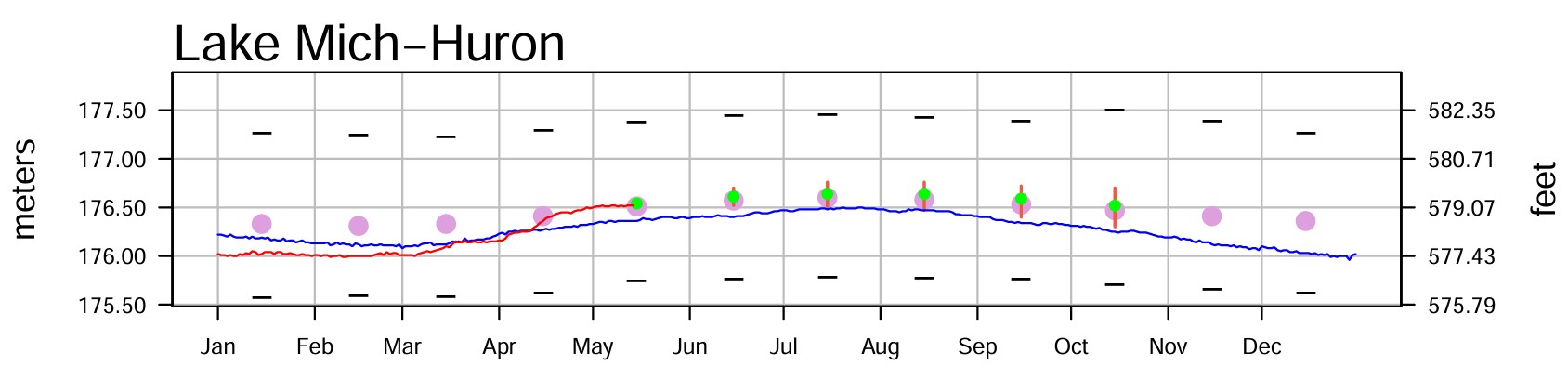
This year’s Great Lakes Commission (GLC) and International Joint Commission (IJC) Annual Meetings were held in Milwaukee Wisconsin on the western shores of Lake Michigan. Both Bob Duncanson and John Wilson (Chair, Water Levels Committee) represented the GBA at the meetings. They were important to attend as they dealt with low water levels in the Middle Lakes, and senior bureaucrats from all US and Canadian federal, provincial/state governments and agencies were present (US Army Corp of Engineers USACE, National Oceanic Atmosphere Administration, Environment Canada, Ministry of Natural Resources, Foreign Affairs, etc.)
The Great Lakes Commission is a US interstate agency established in 1955 that promotes the orderly, integrated and comprehensive development, use and conservation of the water and related natural resources of the Great Lakes basin and St. Lawrence River. Its members include the eight Great Lakes US states, with associate member status for the Canadian provinces of Ontario and Québec. The International Joint Commission, which was created through the Boundary Waters Treaty of 1909 between US and Canada, shares some of the same concerns as
the GLC but is a separate and distinct entity.
The GLC heard from a panel of experts representing differing points of view on how to deal with low water levels in the Middle Lakes. The “Do Nothing” arguments were put forth by Scudder MacKey of Ohio Department of the Natural Resources (DNR), who had worked on the IJC’s International Upper Great Lakes Study and Daniel Injerd of the Illinois DNR. Deborah Lee represented the USACE and presented a more neutral position, while Roger Gauthier of ROWI was the sole participant arguing for the need for compensating measures in the St Clair River.
The debate itself allowed for numerous questionable arguments to be put forward as to why no action should be taken:
• Dredging in the St Clair River took place over 50 years ago and is no longer a factor.
• If compensation measures had been implemented back in the 1970s, the high water in 1986 would have been substantially worse.
• Climate Change is a huge unknown.
• Post-glacial rebound is resulting in higher waters in Lake Michigan.
• Ecological issues resulting from fluctuating water levels are difficult to manage.
• Compensation structures in the St Clair River will negatively affect fish habitat and disturb contaminated sediment.
The Army Corp’s position is that they are neither for or against compensating measures, but they are currently only authorized to study options which address the impact of the 1962 dredging. They also stated that it would take $20 million and 10 years to complete the required study, and, if given approval and funding by both governments, it would be 25 years before the waters would be restored.
Roger Gauthier did well presenting the need for compensating structures based on past dredging, mining and further erosion in the St Clair River. He effectively countered many of the Do Nothing arguments put forth by the other panellists.
The impact of Climate Change was recognized by both sides as a significant driver for future changes in water levels on the Great Lakes. Unfortunately, each participant made reference to their own climate change model that predicted water level changes that supported their own arguments. This disconnect continues to reflect the difficulty in accurately predicting future precipitation, evaporation and runoff across the Great Lakes Region.
One area not addressed in the debate was the significant negative economic impacts that will result from low water levels in the Great Lakes, and the Economic Impact Study by the Mowat Centre that is now underway, and which will quantify the substantive costs to both countries, if action is not taken to deal with this issue.
It was striking that the moderator of the debate allowed only Scudder Mckey to give an overhead presentation at the beginning and end of the debate to outline the background information and material supporting the Do Nothing position. No other panelist was given the same opportunity.
Unfortunately, the Great Lakes Commission probably did not get to hear a balanced debate on low water levels and one hopes more reasoned, non-partisan, scientific work will be made available to the Commission in the future. The lead article in this UPDATE issue sets out how GBA and others are working to counter the Do Nothing positions that were encountered at this conference.
by John Wilson
Chair of GBA Water Levels Committee
And Director for Manitou